Posts

Showing posts with the label #Evolution

Chapter 12: Humanity and the End of Evolution – Eternal Evolution?

Image
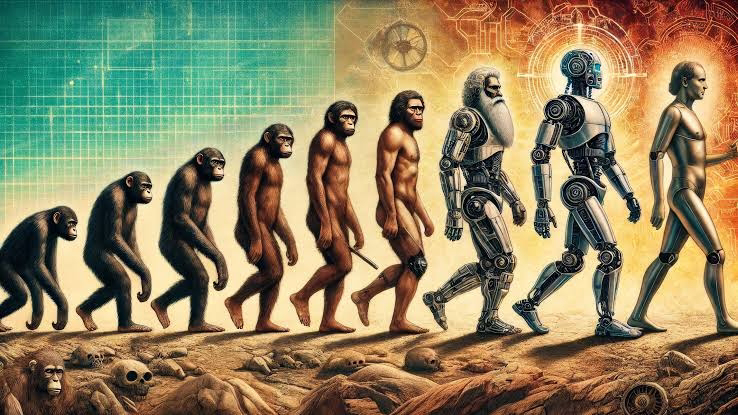
Chapter 12: Humanity and the End of Evolution – Eternal Evolution? Evolution is acontinuous process of change in nature. But does evolution have an end? Will the human species continue its evolutionary journey, or will it reach a final stage? Will humanity remain subject to nature’s evolutionary rules, or will it take evolution into its own hands? These questions make the future of human evolution even more intriguing. In the previous chapter, we discussed how technology and biotechnological advancements are shaping humanity. Now, we will explore some crucial questions about the future of human evolution. Can humans accelerate their evolution using genetic engineering, artificial intelligence, and biotechnology? If so, will this process eventually come to an end, or will humanity be in a state of constant change? The answers to these questions will determine the course of humanity’s evolutionary journey. The End of Evolution: Will Humans Reach Their Final Form? Evoluti...
Chapter 11: The Evolution of Humanity and Potential Future Changes

Image
Chapter 11: The Evolution of Humanity and Potential Future Changes Evolution is a continuous process that has been ongoing since its inception. Every living organism on Earth has undergone evolutionary changes over thousands of years. But what about humanity? The human species has undergone a much faster evolutionary journey compared to other organisms. However, beyond traditional evolutionary processes like natural selection, the evolution of humanity has taken on a completely new dimension thanks to modern science and technology. Today, with advancements in genetic engineering, artificial intelligence, and biotechnology, the pace of evolutionary processes is accelerating. Humanity is pushing the boundaries of biology and taking steps to control its own evolution. In this chapter, we will explore a few different scenarios regarding how the evolutionary journey of humankind may unfold in the future and discuss potential developments that could give a new direction to humanity’s evol...

Chapter 8: Genetics and Evolution – The Role of Genetic Changes in Evolution

Image
Chapter 8: Genetics and Evolution – The Role of Genetic Changes in Evolution The theory of evolution does not solely rely on external factors such as fossil records, morphological similarities, and natural selection. It is also closely linked to changes in the genetic structures of living organisms. Genetics forms the cornerstone of evolutionary changes, and even before Darwin's theory of natural selection, the foundations of genetic science were laid in the late 19th century. However, to understand how genetic science integrates with the theory of evolution, it is essential to know how these two fields complement each other. Genetics: The Cornerstone of Evolutionary Changes Genetics is the branch of science that studies the hereditary units carrying biological traits in living organisms. An organism's genetic structure determines its traits. Genetic material is encoded in DNA and RNA molecules, and this genetic information is passed on from generation to gene...

Chapter 7: Mendel's Genetic Principles and Evolution: The Role of Genetic Variation in Evolution

Image
Chapter 6 Chapter 7: Mendel's Genetic Principles and Evolution: The Role of Genetic Variation in Evolution Genetics forms the foundation of evolutionary biology. Evolution relies on changes that occur over time in the genetic traits of organisms, and most of these changes stem from genetic variation. To understand these variations, we must first explore the genetic principles established by Gregor Mendel. In the 19th century, Mendel's pea plant experiments helped uncover the fundamental laws of inheritance, and his discoveries played a key role in the better understanding of evolutionary theory. In this chapter, we will examine the relationship between Mendel’s genetic principles and evolution, as well as the role of genetic variation in evolutionary processes. Gregor Mendel and the Fundamental Laws of Inheritance Gregor Mendel, through his pea plant experiments conducted between 1856 and 1863, discovered the fundamental laws of inheritance. By examining how heredit...

Chapter 6: Natural Selection and Adaptation: The Engine of Evolution

Image
Chapter 6: Natural Selection and Adaptation: The Engine of Evolution One of the most recognized and important concepts in evolutionary theory is natural selection. This theory, proposed by Charles Darwin in the 19th century, suggests that organisms with traits best suited to their environmental conditions will survive and reproduce, passing their genetic information to the next generation. However, natural selection alone does not drive evolutionary change. The concept of adaptation is also a crucial part of the evolutionary process. Adaptation refers to the biological features that allow organisms to adjust to environmental conditions. Natural selection shapes evolutionary change by selecting for adaptations. In this chapter, we will explore how natural selection works, how organisms adapt to their environments, and the role these processes play in evolution. What is Natural Selection? Natural selection is a process in which individuals with traits that are better suited t...

Chapter 5: Genetics and Mutations: The Fundamental Mechanisms of Evolution

Image
Chapter 5: Genetics and Mutations: The Fundamental Mechanisms of Evolution At the heart of evolutionary biology, there are two crucial concepts: genetics and mutations. These two processes are the fundamental mechanisms driving evolutionary change and play a critical role in our understanding of how natural selection works. Genetics is the system that carries the genetic information of organisms, while mutations are the mechanism that shows how this information can change over time. Evolution occurs as these changes accumulate. In this chapter, we will explore in detail how genetic structure plays a role in evolution and how mutations contribute to evolutionary change. Genetics and Evolution: The Fundamental Connections Genetics is the biological information system that determines all of an organism’s characteristics. This information is stored in a molecule called DNA, which shapes all of an organism’s physical and biological traits. At the core of evolutionary processes l...

Chapter 4: Natural Selection: The Strongest Engine of Evolution

Chapter 4: Natural Selection: The Strongest Engine of Evolution One of the cornerstones of the theory of evolution is the natural selection theory developed by Charles Darwin in the 19th century. Natural selection is one of the most powerful engines of the evolutionary process and is considered a mechanism that determines the survival and reproductive success of species. As one of the foundations of evolutionary biology, this process ensures that nature works in a powerful and effective way. In this chapter, we will explore how natural selection works, Darwin’s theory, and its place in the evolutionary process in detail. What is Natural Selection? Natural selection is the process through which the characteristics of organisms that are capable of surviving and reproducing accumulate. This means that organisms that best adapt to environmental conditions will survive and pass their genetic information to the next generations. The degree to which an organism's characteristics are suite...